Historical
Vignettes
The
Haines "Cut-Off" Road, approximately 160 miles of spectacular
beauty, connects the Alaska Highway at Haines Junction with the Alaskan
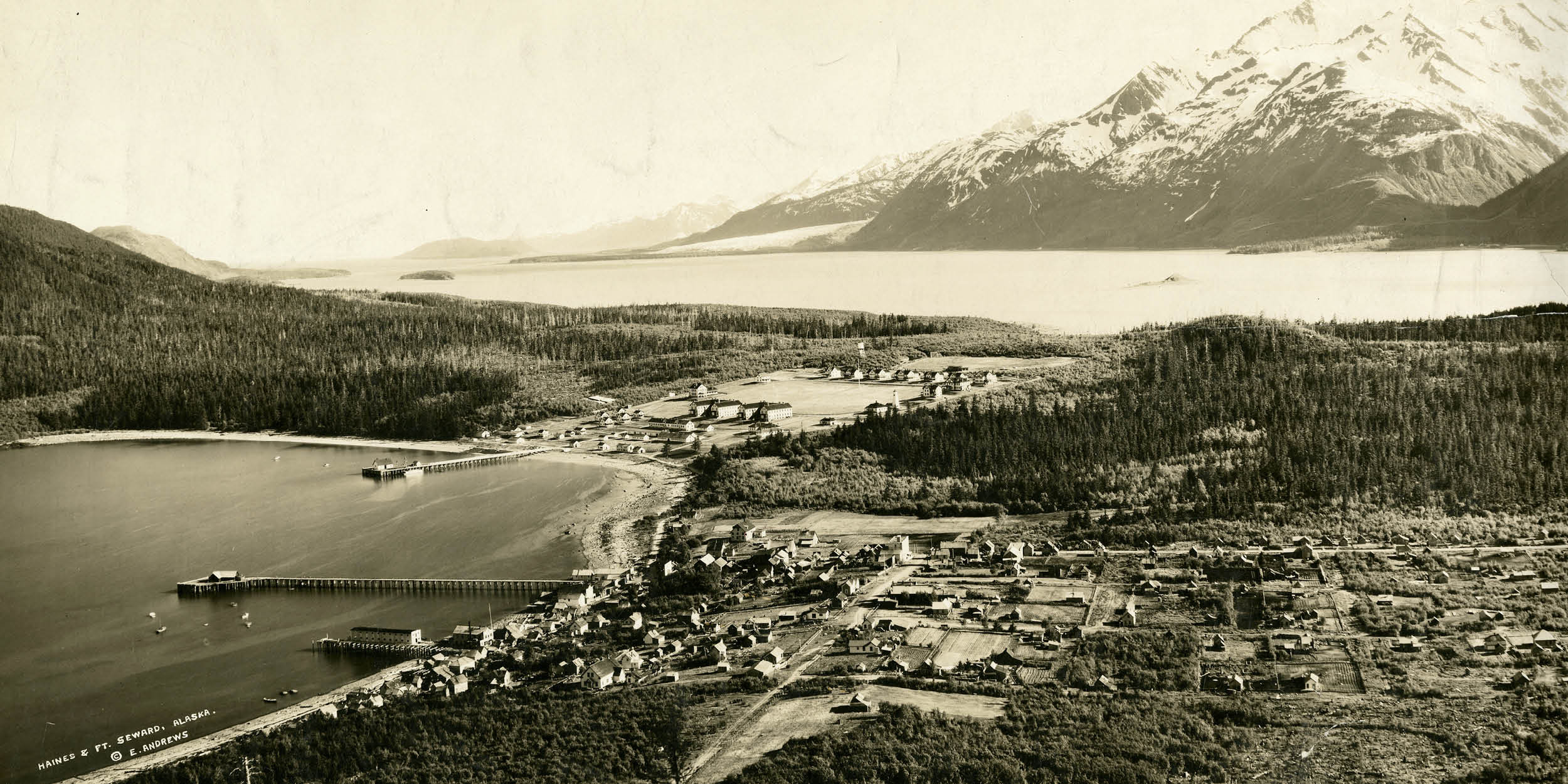
seaport of Haines
It all began
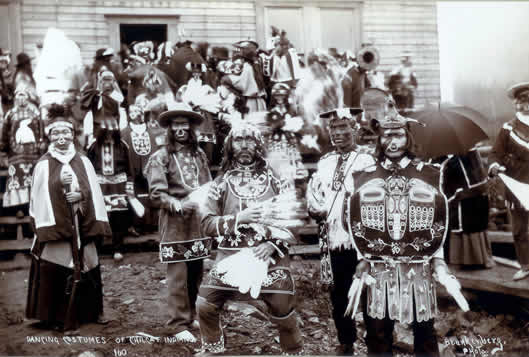
centuries ago with the Chilkat people, members of the coastal Tlingit
Indians. From the ancient village of Klukwan (23 mi. north of Haines)
and other settlements in the vicinity, a well-established trail developed
north to the Interior. This route served as access for a thriving trading
business with other Interior tribes. It followed the Chilkat and Klehini
Rivers through Rainy Hollow, up over the Chilkat Pass, across Stonehouse
Creek, down the Nadahini and Mansfield Creeks and up the Blanchard River
into the Yukon Territory. The trail led along the Blanchard and Tatshenshini
Rivers through what is now known as the Dalton Post area and on to Klukshu
Lake. From here the trail zigzagged along the east side of Dezadeash
Lake on to Champagne via the Dezadeash River.
|

Haines Highway construction, 1943
|
As long ago as 1882 one Arthur
Krause of the Bremen Geographical Society explored this route and made a
remarkably accurate map which was later incorporated in an 1887 paper called
Dawson's Report.
In the early 1890's, Jack Dalton,
an adventurer and entrepreneur of controversial repute improved on a trail
system from Pyramid Harbor, Alaska, on the Chilkat Inlet to the confluence
of the Nordendskiold and Lewis (Yukon) Rivers well within the Yukon. This
trail, developed well before the Klondike gold strike, consisted primarily
of existing Indian trails. Some years earlier, Dalton had built trading
posts at Pleasant Camp (AK/Canadian border) and at Dalton Post, on the Tatshenshini
(now accessed at Mile 104). In spite of some confrontations, Dalton operated
pack train and ox and wagon drayage and drove cattle over the trail with
a certain amount of success and no doubt a share of hardship.
|

Haines Highway construction, 1943
|
From 1897 to 1899 hoards
of optimistic gold seekers used the then well-beaten trail on their
trek north. Locally, in the summer of 1898, placer gold was discovered
on Porcupine Creek, Alaska. By 1899, a wagon road extended from Pyramid
Harbor via Porcupine, along the south side of the Klehini to Pleasant
Camp. By 1914, a good wagon road reached from Haines along the
south side of the Klehini to the international boundary at Pleasant
Camp then along the northern side of the river to Rainy Hollow. A
series of mining discoveries and related activities kept the lower
Dalton Trail active through the years
following its establishment. A wagon road from Pleasant Camp to Rainy
Hollow was built by the B.C. provincial government in 1908/1909 at
which time copper properties near Copper Butte were being developed.
Copper was also discovered in the Three Guardsmen (Mt. Glave) region
in 1909.
|
In 1911, 30 tons of
ore yielding 1,657 oz. of silver and 19,161 lbs. of copper were shipped from
the mine. During this time, Alaska rebuilt the road from Haines to Wells,
constructed a bridge across the Chilkat River and extended the road along
the northern side of the Klehini toward Pleasant Camp. Further up the route
into the Yukon, gold was discovered at Squaw Creek in 1927 by Paddy Duncan,
a Native from Klukshu. During the 30's, 20 to 45 miners worked each summer
on this creek. A large nugget, over 46 oz., was taken on the creek in 1937.
Haines Highway construction camp, 1943
|
The threat
of war on this continent was a reality in 1942. Upon completion of
the pioneer version of the Alaska Highway, the U.S. Government decided
that an alternate access to the highway should be provided in case
the White Pass Railway was blocked. This would provide another supply
route and a possibly important evacuation exit to the coast if needed.
As a result, the Haines road was built in 1943 by the U.S. Army at
a cost of $13 million. The general route of the Dalton Trail was followed
as far as Klukshu Lake. From there the highway took the western shore
of Dezadeash Lake.
Construction
took place from January to December of 1943. One major construction
camp was set up at the Takhane River, Mile 103, present site of Million
Dollar Falls Campground. Another was located at the south end of Dezadeash
Lake, Mile 125, later to be known first as Beloud Post and later as
Dezadeash Lodge. Upon completion of the highway, salvaged building
materials from these camps became prime sources of local building
materials for both private homes and highway lodges.
In the post-war era the
Haines Road served well as an extension of the Alaska Marine Highway
System to northern Alaska. It first opened on a year-round basis in
1963. Considering the severity of winter storms, maintenance of the
highway was and still is a challenge by any man's measure. With extremely
high wind chill factors coupled with drifting snow and poor visibility,
the winding route can be unforgiving. Its maintenance is shared by
AK Department of Transportation and Canadian Territorial camps at
Mule Creek (75 mi.) Blanchard River (94 mi.) and Haines Junction.
During the sixties and early seventies a radio check system operated
which carefully monitored each passing vehicle. Until the early sixties
the passage was seasonal at best. The route was often blocked by a
mudslide near the border. This problem persisted for some forty years
until the slide area was by-passed by new construction in 1983. The
following excerpt from a 1948 B.C. Dept. of Mines Bulletin provides
as interesting insight into transportation conditions in early years.
|
Haines Highway construction blasting, 1943
|
|

Haines Highway construction, 1943
|
"In
the first part of the 1946 season the road was not passable with safety
because of serious flood damage at Stanley Creek, minor damage at
several other creeks and because of a large slide near Pleasant Camp.
A road crew of the Canadian Army had the road in repair by the middle
of the summer and continued improving it until the end of autumn.
Late in the summer, busses started running on a weekly schedule between
Whitehorse and Haines and an officer of the Canadian Customs was stationed
at Pleasant Camp. During the summer of 1945 and 1946 the freight rates
on camping equipment were as follows: Vancouver to Whitehorse, $99
per ton. The freight rates on machinery were: Vancouver to Skagway,
$15 per ton; Vancouver to Whitehorse, $71 per ton. Trucks carrying
freight from Whitehorse along the Alaska Highway charge 10 cents per
ton-mile. Packhorses may be hired from S. Chambers at Champagne, 60
miles west of Whitehorse. The horses may be transported by truck into
the area or may travel on foot over a more direct route by way of
Dezadeash River, Dezadeash Lake, and Klukshu. Provisions and general
supplies are obtainable at Whitehorse, Champagne, and Haines."
In 1954 the Haines Road
once again became the object of an American military-related project
when its route was paralleled by a Haines
to Fairbanks pipeline. The line included associated pump stations
at Mile 48 and Mile 94. A Vancouver joint venture organization built
the 8" line in 1954-1956 under contract with the U.S. Corp. of
Engineers and under the direction and supervision of Fluor Corp.,
a Los Angeles based consulting firm. The line transported many fuels
north including aviation, automobile, diesel and jet, until operations
ceased in 1970.
Commensurate with an American
desire to have an all-paved highway to Alaska, the road is now in
the midst of a major reconstruction funded by the United States. The
"Shakwak" Program, named after the valley in which it lies,
is intended to update the entire route from Pleasant Camp at the Alaska
B.C. border to Beaver Creek at the Yukon-Alaska border. Reconstruction
of the road, designed by Public Works Canada to U.S. specifications,
began in 1979. Segments of the project have been completed from the
border at Pleasant Camp to Mile 74 and from Mile 129 to Haines Junction.
Work is continuing. A testimony to the quality of Public Works Engineering
and quality control, the new sections, often in difficult mountain
terrain, are second to none in excellence.
|
Haines Highway construction, 1943
|
Merle
Lien, Haines Junction
(Condensed from his two-part series, "History of the Haines
Road" printed in Aug. 19 & 26 issues of The Yukon News.)
(c)
Sheldon Museum & Cultural Center, Inc. Box 269 Haines, AK 99827 1(907)
766-2366
All rights reserved. No part
of this webpage may be reproduced, stored in a retrieval system, or transmitted,
in any form or by any means,
electronical, mechanical, recording, or otherwise, without prior written permission
from the Sheldon Museum & Cultural Center.
This webpage may be printed only for personal or classroom use.
Top of Page
[Home]
[General Information ] [Calendar
of Events ] [Collections, Exhibits & Archives
]
[Museum Store ] [Nuggets of
Haines History] [Membership ] [Contact
Us]
Sheldon Museum & Cultural Center, Inc.
Box 269, Haines, AK
99827 - Phone: (907) 766-2366
museumdirector@aptalaska.net